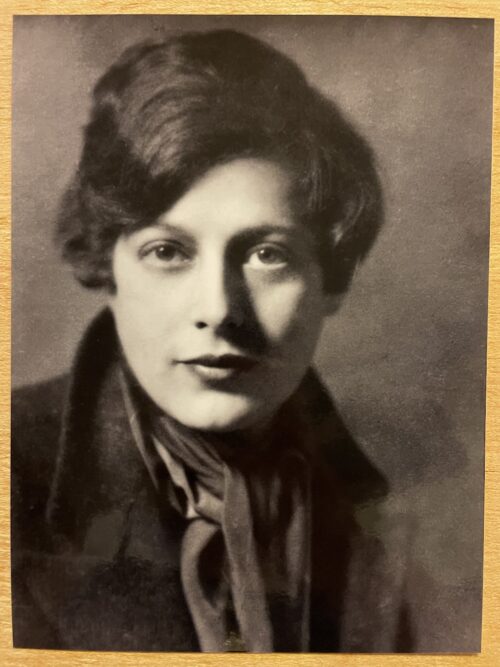
I drove slowly through yet another snowstorm as I left my small Vermont town. Numbers and calculations buzzed in my mind: hours until the baby would need to eat; how long he might sleep; mileage and rest stop locations; how far south the snow might melt; minutes I could stand to listen to his wails, once they began in earnest. Emily “Mickey” Hahn, the New Yorker’s World War II–era China Coast correspondent, would never cancel a trip for either weather or baby, I thought. She would focus on her destination. I conjured her spectral presence in the car, eyed the odometer, glanced at the nest of my son’s car seat, inched down the road. “What would Mickey Hahn do?” I repeated over and over, knowing for sure what the answer would be.
This was the first time that the phrase became a mantra. It would be far from the last.
I spent six years researching and writing a book about Hahn, a pioneering foreign correspondent, and a cohort of women literary journalists working alongside and around her in the 1930s, ‘40s, and ‘50s. I pored over letters and notes from digital and physical archives, read missives between Hahn and her good friend Rebecca West, or between West and Martha Gellhorn, or Gellhorn and her sometime travel companion Virginia Cowles—all accomplished journalists who shared camaraderie, ambition, and mutual admiration.
Not one of them was the type to shy away from any challenge of travel. All four wrote for magazines like the New Yorker and Collier’s, published books of fiction and reporting and memoir and history, and stayed in touch with one another for years of their lives, sharing their successes and woes. Where relationships among the four stopped short of close friendship, they remained important to each woman. The world was a workplace, and they were tightly knit colleagues, no matter how dispersed.
Building these laudable careers at a time when women weren’t wholeheartedly welcomed in the workforce hadn’t been easy for them personally or professionally, I knew. Various journalists had convinced editors to hire them despite the fact that they didn’t, as a rule, “have women on the staff.” I read Gellhorn’s frustration after pitching an editor on what she knew in her bones was the important story about war: how people got their hands on food and what the movement of that food, the ingenuity its acquisition implied, told her. “Stale by the time we publish,” her editor had cabled, though mainstream journalism would eventually catch up to Gellhorn. Nowadays, human-interest stories about food and daily life, tales about the everyday people impacted by conflict, are an established part of war coverage.
There were more personal challenges for these women, too. I read the letters Hahn and West traded as they tried to convince their spouses that they needed to go on yet another research trip. Hahn’s husband, generally supportive of her career, could lean pedantic as he wrote her about “a mother’s duty,” when she wanted to stay away from their daughters for too long. I delighted in the list she used to counter his badgering her to come home, pointing to why he should instead send the girls, who were old enough to travel alone by then, out to her in Taiwan: kind people, plenty of good, cheap food, knowledgeable doctors, and “wonderful exploratory trips.” Still: the girls stayed home in England.
When I looked up from all this research, I realized I’d changed. My imposter syndrome had shifted to general impatience somewhere along the line. I couldn’t possibly have been more grateful.
Imposter syndrome is an insidious little instinct. Years ago, in my twenties, it kept me second-guessing my interactions with colleagues, hedging and wondering over pitches and pieces, waiting for some elusive sense of authority to take a big swing. Somehow, that feeling of authority never seemed to arrive. That anxiety faded a bit with time, as I learned to trust my instinct for story and got to know the editors with whom I worked. But then I had three children. And as I wrote about these bold women and their exploits while they grew through infancy and toddlerhood, imposter syndrome convinced me that I simply didn’t have a solid sense of daring anymore. My own boldness had become a relic of my pre-child life, I feared. Doubt is corrosive like that, shapeshifting alongside any insecurity, filling any vacuum.
Reading these women saved me from feeling alone in the effort to sustain a public life amid very real private demands of a family I wholeheartedly adore, at a time when the roles women are supposed to play are subject to scrutiny all over again. They’d had arguments over “a woman’s place” at dinner parties and school pick-ups, eighty years before tradwives offered video windows into family-oriented days. “But I do think a woman’s place is in the home,” another mother had insisted to Hahn in the 1950s, “right in front of a lot of people, too,” as she wrote to West after the fact. This woman’s perspective was held by the majority. A traditionalist attitude wasn’t the woman’s fault, per se, since that woman had never worked for a living and didn’t know any different, Hahn reminded herself, “once the red mist cleared from my eyes.”
Though Hahn wouldn’t bow to that sort of pressure, the fact that it haunted her gave me a perverse sort of pleasure. She hadn’t known exactly how to do it, either, I thought, satisfied. And she was far from alone in trying to figure out which duties to her family she should heed and which could be traced directly to outdated norms that preferred to keep women in controlled roles. Gellhorn had written, too, about how she understood she was to be a “good little wife” to Ernest Hemingway, “who is my job.” She hadn’t been able to either subsume herself completely or draw mutually satisfactory lines with him; the marriage didn’t last.
I stopped feeling alone in persistent uncertainties about the quality of my writing. I knew how a mistake West had once made in print had gnawed at her self-confidence, and my admiration for the work she went on to write afterwards, once she got over her shame and just kept going, made me approach my own failings with more grace and humility. I read Gellhorn lamenting how flat her writing felt for a brief period of time. “What I do not have is majic,” she fretted to a friend, “but majic is all that counts.” At a distance of decades from that phrase, having read all she wrote later, I had the luxury of smiling. How wonderful that she’d been so wrong.
Over the years, the specificity of these women’s words has pealed through my life like a bell. A jotted note between Hahn and West, commiserating over the complications of having children and spouses and all the love that kept them (us) from the purity of work, work, work. “Families are the devil, Rebecca, I’m very sorry,” she wrote when West wrote to ask her advice about a tricky dynamic. I sang those words in cheerful refrain to my infant daughter as we played with the cream-colored pile of the carpet in her room, in the years when I felt I might scream from the compressed adoration, boredom, and exhaustion of life with three very small children. I thought of the sheer delight Gellhorn gleaned from solitary travel, to any new place, in every single epoch of her life, and the ways she phrased it differently over the years. “My heart rose like a bird at once,” she once wrote. “It always did incurably, except in rain, as soon as I felt I had fallen off the map.” Mine does, too, which I remembered on the few solo trips I’ve taken in these years.
My heart certainly rose those six years ago, when my son and I made our way south through the snowstorm and into a different climate altogether and, finally, to our destination. We’d only been driving five hours south to New York City—hardly the exotic locales to which Mickey Hahn had gotten—but it was Hahn’s influence that lent levity to the hairier moments of travel with an infant, both then and in countless moments in transit with children in the years since.
For a woman, boldness, I think, isn’t a single decision or a static attitude. It is, like any other trait or habit, a constant recalibration, a willingness to re-examine a personal instinct with vulnerability and honesty while at the same time ignoring the external voices that echo patriarchal norms—which are suddenly very loud all over again these days. Knowing these writers’ work and lives so deeply for these years lifted the weight of my imposter syndrome. But it also gave me a new compass by which to orient myself in much broader circumstances. I ask myself “W. W. M. H. D.” whenever I face a crossroads of family and work. The answer is not always as clear as it was in that snowstorm, and I don’t often do what I think Hahn might have. We are very different, I know now. Even so, her influence is never wasted.