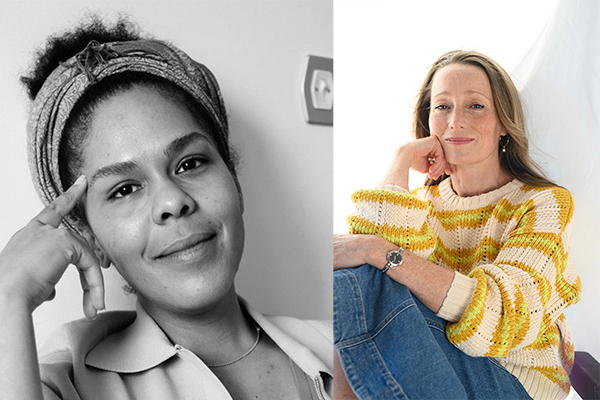
Author Djaimilia Pereira de Almeida and translator Alison Entrekin, collaborators on Three Stories of Forgetting, interviewed each other about writing, working on multiple projects at the same time, and how “translation is writing in a straitjacket.”
Alison Entrekin interviews Djaimilia Pereira de Almeida
Alison Entrekin: At what moment in your life did you become a writer? When was the moment that you thought, “This is what I want to do?”
Djaimilia Pereira de Almeida: Perhaps at a time in my thirties when I found myself unemployed and ill. Trying to write helped me survive and gave me back my strength. And, little by little, I began to feel that I was capable and that writing could save my life.
AE: What are your literary influences, the books and writers that have most impacted you?
DPA: Flaubert, Fernando Pessoa, Raul Brandão, Sá de Miranda, Maria Velho da Costa.
AE: Which of your books was the most difficult to write?
DPA: Livro da Doença, my most recent novel.
AE: Do you have different books going at any one time or do you work on only one at a time?
DPA: Yes. I usually work on two projects at the same time, jumping from one to the other, and sometimes I finish both at the same time.
AE: Do you start with a plan or map of where you are going, or is each book a voyage of discovery?
DPA: I like not knowing where I’m going. Sometimes there’s a phrase, a few guiding lines, but I rarely know the way, and that’s what I love about it.
AE: How do you build your characters—do they come fully formed, or evolve as you write?
DPA: It’s like getting to know someone: they evolve as I get to know them, as they let me get to know them. Characters close themselves off if we approach them rudely. In my case, I build them as if I were courting them, circling around them like an insect.
AE: What’s your favorite part of the writing process: drafting, revising, or editing?
DPA: Revising, without a doubt. It’s similar to embroidery.
AE: What is it like having your work translated? (I imagine it could be quite terrifying!)
DPA: It’s very exciting. In the languages I have a reasonable command of, I try to listen to myself in the translations, but in general I’m just immensely happy to find translators—fellow authors—who will help my books travel.
Djaimilia Pereira de Almeida interviews Alison Entrekin
Djaimilia Pereira de Almeida: Many translators also write: do you?
Alison Entrekin: I do, but writing has taken a back seat to my translation work for a long time, especially in the last decade, as I was recreating João Guimarães Rosa’s Grande Sertão: Veredas in English (soon to be published as Vastlands: The Crossing). It took every iota of creativity I had to give, but now that I’m done I find I am having urges to write again.
DPA: How do you feel about the process of translation, at what moment do you become—as I consider all translators to be—co-author of the texts you translate?
AE: Thank you for asking! I consider myself a “co-creator” or “author of the translation” rather than a “co-author” per se. Translation is writing in a straitjacket; we have no control over plot, or characters, or what they say and do. But we do control the words. We reclothe a book in another language like master tailors. It’s such a fascinating, complex literary art, quite different from original authorship, which is why I like to keep the names separate. But to answer your question, I think it’s somewhere in the revision that I truly begin to feel some kind of ownership.
DPA: Which was the most difficult book to translate?
AE: Grande Sertão: Veredas (Vastlands: The Crossing), without a doubt. Nothing else even comes close.
DPA: What book would you love to have translated?
AE: Something by Roberto Bolaño, if I translated from Spanish.
DPA: What book would you like to have written?
AE: The Animals in That Country by Laura Jean McKay.
DPA: What got you interested in the Portuguese language? Do you translate from other languages?
AE: I lived in Brazil for nearly 25 years, and I studied translation in São Paulo, so Portuguese was an obvious choice. I can read Spanish, but I don’t dare translate from it because I don’t have the lived experience of the language that I believe is so essential to the work of a literary translator.
DPA: What are your favourite books of all time?
AE: The Lover by Marguerite Duras, translated by Barbara Bray. One Hundred Years of Solitude by Gabriel García Márquez, translated by Gregory Rabassa. Monkey Grip by Helen Garner. The Chronicles of Narnia by C. S. Lewis.
DPA: What qualities do you most appreciate in a translation?
AE: Deep reading, accuracy, and a genuine effort to seek out the qualities that make the work special in the original and to reproduce those things
Djaimilia Pereira de Almeida was born in Luanda, Angola, and raised in Portugal. She is the author of acclaimed novels including That Hair, a finalist for the PEN Translation Prize, and her work has won the Vergílio Ferreira Prize and the Oceanos Prize. Her stories and essays have appeared in Granta and Words Without Borders, among other publications.
Alison Entrekin is an award-winning Australian literary translator from the Portuguese. She has translated many of Brazil’s most beloved and iconic literary works, including Clarice Lispector’s 1943 debut novel Near to the Wild Heart, the favela classic City of God by Paulo Lins, and José Mauro de Vasconcelos’s My Sweet Orange Tree.