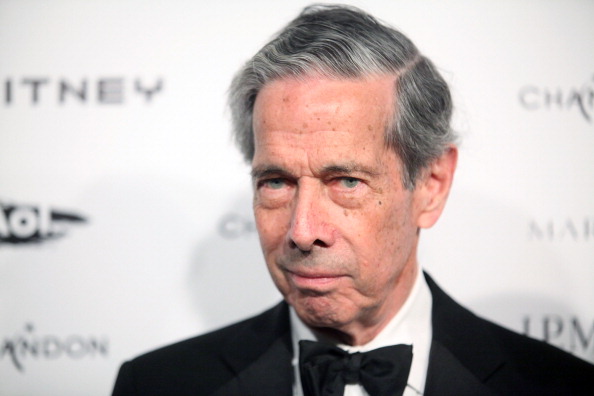
On June 10, hundreds of artists and writers poured into the American Wing of the Metropolitan Museum to pay tribute to celebrated New Yorker writer Calvin “Tad” Tomkins, who died on March 20 at the age of 100.
As the memorial opened, the introduction to Mozart’s Requiem resounded throughout the glass-enclosed courtyard, followed by a welcome from the Met’s director, Max Hollein. Remembrances by David Remnick, Massimiliano Gioni, and family members evoked Tad’s unique place in American culture and the qualities that made him such a distinct and beloved figure. An excerpt from Remnick’s homage follows:
Good morning.
I want to assure Dodie and all of you that even if you had scheduled this service for tonight—game four of the NBA Finals—I would have chosen to be here. That’s how much I loved the man. Of course, I wouldn’t have stayed for any of the other speeches. There’s just so much the dead can require of the living. I’m kidding . . . I would have recorded the game. Such is the measure of my affections.
My colleagues and I worked alongside Tad Tomkins at The New Yorker for the last thirty or so years of his life. Lucky me. He was a master of his form and at the same time utterly lacking in ego; he was a person of genuine kindness, unassuming talent, considerable will, and twinkly wit. Tad loved being alive. And he was determined to stay that way. So much so that his death at the age of a hundred seemed somehow . . . premature. As you will read when his book comes out early next year, he kept adding to the diary of his centenary year weeks past its publication in The New Yorker. I imagine he is writing still.
I often think of Tad as the most gracefully erudite and sophisticated person I’ve ever known. He was without pretension—an achievement, considering his talent and the world he inhabited––and yet he was one of the great cultural chroniclers of his age. Without making a big thing of it, he seemed to know everyone, and invariably by their first names. Jasper. Cindy. Thelma. Rashid. He was a journalist-flâneur, always on the hunt for new sensations, new art. He and Dodie knew what was happening now more than any hotshot up-and-comer. They’d come to the office to report that they had just seen so-and-so’s new work—the paint was still wet!—but it’s still a secret so tell no one. I struggled to keep up.
Tad was experienced, too, in matters of the heart. And he was lucky in love. And absurdly handsome. He had the wit to live his last decades, his happiest decades, with the love of his life, his sustenance, Dodie Kazanjian. In his writing, in his longevity, she was his unindicted co-conspirator. Their conversation was constant and alive.
Tad’s prose was crystalline; it had the cool clarity of a well-iced martini. His beloved editor Cressida Leyshon will, I think, admit that he left her with little to do. My own editorial role, it seemed to me, was to call and tell him how deeply I enjoyed the current piece and what was he thinking about for the next . . .
One of the privileges of my job at The New Yorker is that it’s not uncommon to begin one day having breakfast with a writer so young that she thinks of Radiohead as an oldies nostalgia band and then ending the day at dinner with a writer of Tad’s vintage and distinction, who, as a journalist, sat across the table from Marcel Duchamp, Merce Cunningham, Philip Johnson, the Murphys.
From the time he started publishing profiles in The New Yorker in the early Sixties, Tad was for American modernity what Vasari was for the Renaissance. Just as Vasari wrote profiles of all the artists hanging around sixteenth-century Venice and Florence—Leonardo, Raphael, Michelangelo, Titian, and many lesser figures—Tad recorded his own times and its masters. Rauschenberg. O’Keefe. Johns. His sense of wonder, if anything, expanded with time. Even as his physical powers weakened, the lens of his curiosity widened and took in David Hammons, Laurie Simmons, John Currin, Kerry James Marshall, Rashid Johnson . . . Dodie, his fellow-traveller in all things, shlepped him from gallery to studio to loft, to see, to listen, to ask questions of young artists. Future scholars of Tomkins studies will quickly object and mention that Tad also profiled the likes of John McEnroe and Julia Child—but who would be churlish enough not to count them as modern artists, too?
When Tad reached the still-adolescent age of seventy-five, Dodie threw the most touching and imaginative birthday party ever thrown for a writer. She assembled as many of his profile subjects around the tables as mortality allowed.
Now, you have to understand, for most journalists, especially political journalists—this is certainly the case for me—if you write a profile of someone, and write it with any measure of honesty, warts and all, you quietly wish that your subject, before he gets a chance to encounter you again, will get hit by a bus. This is uncharitable, and possibly criminal to admit. But true.
And yet there they were at the dinner, all of Tad’s subjects, as if in a dream, floating through the room and past the gaze of their finest chronicler. There they were drinking Dodie’s wine, eating Dodie’s food, being themselves. Christo, Rosamund Bernier, Cindy Sherman, Jonas Mekas, Frank Stella, Philippe Petit, John McEnroe.
What stunned me is that all of these people were entirely warm to Tad. They adored him. And it wasn’t because he had lionized them. It was because he had seen them and what they did with uncommon clarity. That’s what he did from the start.
In 1962, the earliest days of Tad’s career at the magazine, he profiled a Rube Goldberg-like artist. His piece began like this:
It is characteristic of Jean Tinguely, the Swiss motion sculptor that the bizarre, down-at-heel, anti-functional machines that constitute his art usually fail to work in the way they are expected to, and sometimes they do not work at all. This is not always the fault of the machines. In Amsterdam last spring, at the opening of a comprehensive show called “Art in Motion,” a large Tinguely “meta-matic” painting machine, powered by a gasoline engine, was installed in the reception room, where it was supposed to produce abstract drawings and at the same time pump the exhaust from its engine into a balloon, which would eventually fill up and explode, pouring forth fumes and driving the guests from the room; the machine was unable to do any of this, because another artist, perhaps enraged at such theatrical egocentricity in a mere machine, had poured beer into its fuel tank.
That is the sound of Tad Tomkins. Clear. Sly. Full of wonder. Full of life. That is his voice. You hear it in all those many profiles. And, perhaps most vividly of all, you can hear him in the diary of his last year, his hundredth. We all miss Tad Tomkins. His presence among us. The lucky thing, of course, is that his voice, the heart of what remains, is always available, right there on the shelf, a continuing presence in all of our lives to the end.
Passages from Centenarian: A Diary (Farrar, Straus and Giroux, February 2027), were then read by Walton Ford, Ragnar Kjartansson, John McEnroe, John Currin, and Cecily Brown. As Brown read the poignant final words of the book, she and many in the audience were visibly moved.
Tad’s wife, Dodie, concluded the readings with a beautiful letter written by Tad early in his career, to the artist Gerald Murphy. That letter described the book taking shape in Tad’s mind about the Murphys’ expatriate life in the south of France in the 1920s. Originally a New Yorker profile and now a literary classic, Living Well is the Best Revenge will be republished in February by Picador, with a foreword by Anna Wintour.
At the memorial’s close, Alphonso Horne on trumpet, with his Gotham Kings brass band, erupted into a triumphant “When the Saints Go Marching In.”